
A guide to the ideas, methods and original thinking of futurist Tracey Follows.
The future is not made by systems alone. Nor does it emerge solely from individual intentions and choices.
Technologies, institutions, markets, cultures and infrastructures shape the conditions in which we live. But people also interpret, influence, challenge and transform those systems.
Tracey Follows' work examines this relationship, bringing together the study of large-scale change with the possibilities, choices and agency of the people living through it.
Every future is written between the system and the self.
Through Futuremade, System & Self and her wider research, Tracey explores how this relationship can help us understand, anticipate and create alternative futures.
Who is Tracey Follows?
1
Tracey Follows is a British futurist, author and strategic foresight adviser known for exploring the relationship between large-scale systems and human lives.
Her professional work spans technological, economic, geopolitical, commercial and societal futures, combining more than 30 years of experience in corporate strategy, industry leadership and strategic foresight.
She is the founder of Futuremade, creator of the System & Self futures framework, and author of The Future of You. Her original research includes Me, the Database Brand, and work on prediction, identity, agency and human–machine futures.
She describes her intellectual territory as the system and the self, examining not only the forces changing the world, but what emerges through their relationship with the people living within it.
What is Futuremade?
2
Futuremade is the strategic foresight practice founded by Tracey Follows in 2015.
It works with organisations and leaders to understand technological, economic and societal transformation, anticipate emerging futures and develop the capacity to make informed strategic choices.
Futuremade is also the home of Tracey's original futures research, frameworks, publications and educational programmes, including System & Self and Me:chine.
System & Self is a methodology developed within Futuremade. It is not a separate company.
What is the central idea behind the work?
3
The self sits at the centre of futures thinking.
Futures are often described from the outside in: technologies, economies, institutions, demographics and systems change, and people appear at the end as recipients of those changes.
But people are not endpoints of trends.
We interpret change, resist it, adapt to it, imagine alternatives and act.
Every future has to be inhabited. The question is whether the self is merely accommodated by the future — or remains capable of participating in its actual creation.
This leads to the proposition at the heart of the work:
Every future is written between the system and the self.
Systems shape conditions.
Selves give them meaning.
What is The Future Of You?
4
Future Of You is the proposition that the individuated self belongs in the future as an active participant and author, not merely as something acted upon, represented or accommodated by change.
The 2021 book The Future of You: Can Your Identity Survive 21st-Century Technology? began by asking what technology was doing to identity: how people were becoming increasingly knowable, measurable, machine-readable and digitally mediated.
Future Of You Five Years On (a new book published in 2026) carried that inquiry forward from machine-readability.
But now machine-readability is becoming part of the ordinary condition of contemporary life. The next question is more fundamental:
What place does the self occupy in the making of the future?
@FutureofYou explores how the individual self remains capable of agency, authorship, imagination and choice in futures increasingly shaped by technological and institutional systems.
It is not simply about predicting what technology will do to us.
It asks how we remain present in — and participate in creating — what comes next in the age of AI.
The future isn’t only something happening around us. The future is us.
What does it mean for the self to have a place in the future?
5
It does not mean simply giving people a voice in collective processes of foresight or inviting “the public” to participate in shaping preferred futures.
The concern here is more specific:
the future of the individuated self.
How does a particular person retain the capacity to orientate themselves, make judgments, exercise agency, imagine alternatives and author a life when increasingly powerful systems anticipate, personalise, recommend, automate and act on their behalf?
Participatory futures often ask how groups, communities or publics can take part in making the future.
Future of You asks whether the individual can still participate in making their own future.
That distinction matters.
The self is not being used as shorthand for “people” or “society”. It means selfhood: the singular locus of experience, intention, judgment, imagination and authorship.
The aim is not simply inclusion in somebody else’s future-making process. It is the preservation and expansion of an individual’s capacity to become an authoring agent within the future itself.
Most futures practitioners increasingly recognise that people may resist, fear or struggle with uncertain futures. But treating people as participants in a foresight process is not the same as treating the self as part of what is being transformed by the future. I believe that:
People are not only participants in futures. They are one of the things the future is making.
What is System & Self?
6
System & Self is a worldview and strategic foresight method developed by Tracey Follows for examining futures through the relationship between the systems shaping our possibilities and the selves living within them.
Its starting point is simple:
You cannot understand the future by studying systems alone.
Technology, policy, economics, platforms, institutions and infrastructure alter the realm of possibility. But futures are ultimately lived through bodies, identities, relationships, memories, expectations, judgments and choices.
System & Self therefore asks us to look in both directions at once.
What is the system making easier?
What is it making harder?
What does it notice?
What does it ignore?
What kind of behaviour does it reward?
And then:
What is this system doing to the self?
What kind of person does it ask us to become?
Where does agency still live?
What happens when systems move faster than selves?
System & Self is not a binary in which systems are bad and selves are good. It is a figure–ground relationship. Each changes what becomes visible in the other.
The future appears in the connection.
Why put the self into strategic foresight?
7
Because an externally plausible future is not necessarily a humanly inhabitable one.
Traditional foresight is often very good at describing changing systems: new technologies, new business models, new demographic patterns, new regulations, new geopolitical configurations.
But those systems do not simply arrive intact and act upon passive recipients.
People interpret them.
They appropriate them.
They resist them.
They become accustomed to them.
They imagine different uses for them.
They sometimes refuse them altogether.
And they themselves change in response.
Putting the self into foresight therefore changes the questions we ask.
Instead of asking only:
What will AI be able to do?
We can also ask:
What kind of person does an AI-mediated world make possible — or necessary?
Instead of asking only:
How will work change?
We can ask:
What kind of worker does this system ask us to become?
Instead of treating human consequences as an afterthought, identity, agency, imagination, embodiment and meaning become part of the foresight itself.
What is the System & Self card deck?
8
The System & Self card deck is a practical expression of the System & Self method.
The instruction is deliberately simple:
Pick a System card. Pick a Self card. See your future in the connection.
System cards surface forces such as anticipation, addressability, exposure, atmosphere, time and space.
Self cards surface questions of memory, orientation, agency and what remains beyond straightforward machinability.
Placing one beside the other creates a tension, question or possibility that conventional trend analysis can miss.
The cards do not contain a predetermined answer. The insight comes from the relationship between them.
The deck can be used individually, in teams, in workshops or simply as a way of unsettling a strategic question that has become too familiar.
What is Me:chine?
9
Me:chine is Tracey Follows’ research territory for understanding the human being in a world increasingly organised around machine-readability.
The word brings together me and machine.
Contemporary systems work most easily with what can be captured, classified, quantified, processed and predicted. Increasingly, parts of the self are translated into those forms: faces, voices, movements, locations, preferences, relationships, behaviours, biometrics and intentions.
This makes more of us machinable.
But a human being is not exhausted by what a system can read.
Me:chine therefore explores the relationship between the machinable and the unmachinable: between those aspects of human life that can be rendered computationally legible and those that remain embodied, intuitive, imaginative, temporal, ambiguous or otherwise resistant to complete capture.
Its question is not simply:
How much of me can a machine know?
It is also:
What happens to whatever the machine cannot read?
Me:chine is not an argument against machines. It is an investigation into the conditions for remaining fully human among them.
Me first. Machine second. ME:CHINE
The colon matters because it both separates and connects. It refuses to collapse one side into the other. It insists that the relationship itself deserves our attention.
The machine is here. So are we. Neither of us leaves this encounter unchanged. The future will be made in that space between.
What does “machine-readable self” mean?
10
System & Self is a worldview and strategic foresight method developed by Tracey Follows for examining futures through the relationship between the systems shaping our possibilities and the selves living within them.
Its starting point is simple:
A machine-readable self is the version of a person that can be rendered legible to computational systems.
It is assembled through data.
That data can describe what you have done, where you have been, whom you know, what you look like, what you buy, how you move, what you pay attention to and increasingly what a system predicts you are likely to do next.
Machine-readability has enormous utility. It allows systems to recognise us, authenticate us, recommend things to us, personalise services and automate decisions.
But it also produces a consequential gap:
the gap between the person and the computational representation of the person.
The more consequential that representation becomes, the more important the gap becomes too.
What is the Database Self?
11
The Database Self is the identity assembled about a person through data, classification and inference.
Once, identity was principally something we expressed to other people.
Increasingly, identity is also something systems calculate.
A Database Self can contain information you deliberately supplied, information observed about your behaviour, information obtained from elsewhere, and information inferred probabilistically by machines.
That computational version of you may help determine what you see, how you are ranked, whether you are trusted, what you are offered, what risks are attributed to you and what opportunities become available.
An increasingly important identity question is therefore no longer simply:
Who am I?
It is:
Who do the systems think I am?
And after that:
What happens when their version begins acting in the world before I do?
How is the Database Self different from the self?
12
The Database Self is a representation of the person. It is not the entirety of the person.
That distinction becomes more important as computational representations acquire greater power.
Systems prefer what they can recognise, compare, classify and process.
People also contain ambiguity, contradiction, imagination, embodiment, memory, intuition, unrealised possibility and the capacity to change.
The danger is therefore not simply that a database might contain inaccurate information.
The deeper question is what happens when the readable version of a person acquires greater operational power than the person it represents.
A prediction can precede an explanation.
An inference can get turned into an identity.
A possibility can become a probability.
And a probability can become a tyranny.
That is why machine-readable identity ultimately becomes a question of agency.
What is the Database Brand?
13
The Database Brand is the computational representation of a brand as it is assembled, interpreted and acted upon by machines.
For decades, organisations designed brands primarily for human perception. They created identities, stories, campaigns, language and experiences in an attempt to influence what people thought and felt about them.
AI introduces another interpreter.
Machines increasingly encounter information about an organisation, synthesise it, rank it, infer relationships around it and use that interpretation when answering, recommending or acting on behalf of people.
The obvious strategic question is:
How do I make my brand visible to AI?
But that is only the beginning.
The more important questions are:
What is AI changing about people?
What is AI changing about brands?
And therefore, what is changing about the relationship between the two?
When both sides of the relationship are increasingly being interpreted by machines, branding is no longer solely a matter of designed communication.
It becomes partly a matter of computational identity.
The designed self becomes the Database Self.
The designed brand becomes the Database Brand.
And the relationship between them becomes increasingly machine-mediated.
How do Future Of You, System & Self and Me:chine connect?
14
They are different expressions of the same body of work.
Future Of You asks the human question: where does the self sit in the future, and how does the individual remain a participant in making it?
System & Self provides the lens and method: futures emerge through the relationship between the systems shaping our possibilities and the selves interpreting, resisting, adapting to and acting within them.
Me:chine investigates the emerging frontier: what happens as technological systems begin participating in the making of the self itself. And what remains machinable and unmachinable in being human?
Together, they describe a developing inquiry:
the future of the self → the relationship between system and self → the changing constitution of the self in the synthetic age
The 2021 Future of You began with machine-readable identity.
System & Self widened the inquiry into a way of seeing futures.
Me:chine follows the question further, into a world in which the boundary between the person and the systems interpreting, anticipating and augmenting them becomes increasingly difficult to locate.
FUTURE OF YOU asks: What is technology doing to who we are?
SYSTEM & SELF asks: What happens between the systems shaping us and the selves living within them?
ME:CHINE asks: What happens when machines begin to participate in the making of the self?
What is ‘Before We Get There’?
15
Before We Get There is the cultural storytelling territory of Tracey Follows’ work: a way of noticing where the future is already appearing before we have fully named it.
The future rarely comes labelled as “the future”.
Something alien that suddenly feels ordinary. Something normal suddenly feels out of synch.
Before We Get There looks for those moments because culture can make a future visible before formal forecasting has found the language for it.
A luxury campaign can become a way into the polymorphic or prismatic self.
A cultural obsession with prediction can reveal something about agency.
A piece of wearable technology can raise a deeper question about who gets to assemble the versions of ourselves through which we experience the world.
This is not trend spotting for its own sake.
It is an attempt to notice where tomorrow has already begun but has not yet been recognised as tomorrow.
What areas does Tracey Follows research?
16
Tracey Follows' work spans technological, economic, commercial and societal futures, with particular attention to how systems reshape the conditions in which people and organisations live, work and make decisions.
Her research includes artificial intelligence, the Database Condition, the Database Brand, emerging technological infrastructures, prediction and anticipation, personal futures, human agency, digital identity, cognitive security, embodiment and human–machine relationships.
These connected areas are explored through System & Self, her broader futures methodology, and Me:chine, her more specialised research into machinable and unmachinable human capabilities.
The underlying inquiry is not simply what the future will bring, or what it will mean for the individual.
It is what happens between the systems shaping our futures and the people living, interpreting and transforming them.
What does all this mean for organisations?
17
It means that futures work cannot stop at describing external change.
An organisation may understand that AI will transform its industry and still misunderstand the future if it has not asked what AI changes about its customers, employees, leaders and institutions.
The strategic challenge is not merely adapting an organisation to a new technological system.
It is understanding the people that system helps to produce.
Who becomes more powerful?
Who becomes more legible?
What disappears from view?
What behaviours are rewarded?
What judgments are delegated?
What becomes effortless?
What becomes difficult?
What new expectations become normal?
And what human capacities become more valuable precisely because they are difficult to machine?
This is where foresight moves beyond forecasting change and begins examining its consequences for agency, identity and meaning in the synthetic age.
What kind of future is Futuremade interested in?
18
Futuremade is not concerned with prescribing one ideal future.
It is concerned with preserving the conditions under which more than one future can still be imagined, chosen and authored.
Systems will inevitably shape what becomes possible.
But systems should not be the only authors of possibility.
The future also requires individuals with enough agency to judge, enough imagination to envisage alternatives, enough orientation to understand where they stand, and enough authorship to act.
That is why the work ultimately returns to the self.
Not the self as consumer.
Not the self as data point.
Not the self as stakeholder.
Not the self as an endpoint of a trend.
The self as an authoring agent in its own future.
Because the question is not merely what future is coming.
It is:
Who gets to participate in making it?
And, at the most personal level:
Can the future still be mine?
Every future is written between the system and the self.
What does “Every future is written between the system and the self” mean?
19
It means that no future is created by systems alone.
Technologies, institutions, markets, policies, infrastructures and cultures shape the conditions in which people live. And traditionally Futures Studies and Strategic Foresight have focused on these driving forces. However, personal futures are essential to change too: they influence what is possible, what is rewarded, what is visible, what becomes normal and what choices are available.
“Every future is written between the system and the self” is therefore both a description and a method.
It describes the future as something formed through the interaction between external systems and human beings, or external macro futures and interior personal futures.
And it offers a way of thinking about change: look at the system, look at the self, then look at what is happening between them - the tensions, the challenges, the opportunities.
Every future has to be inhabited.
And a future without personal agency is not much of a future at all.
Systems shape conditions. Selves give them meaning. Every future is written between the system and the self.
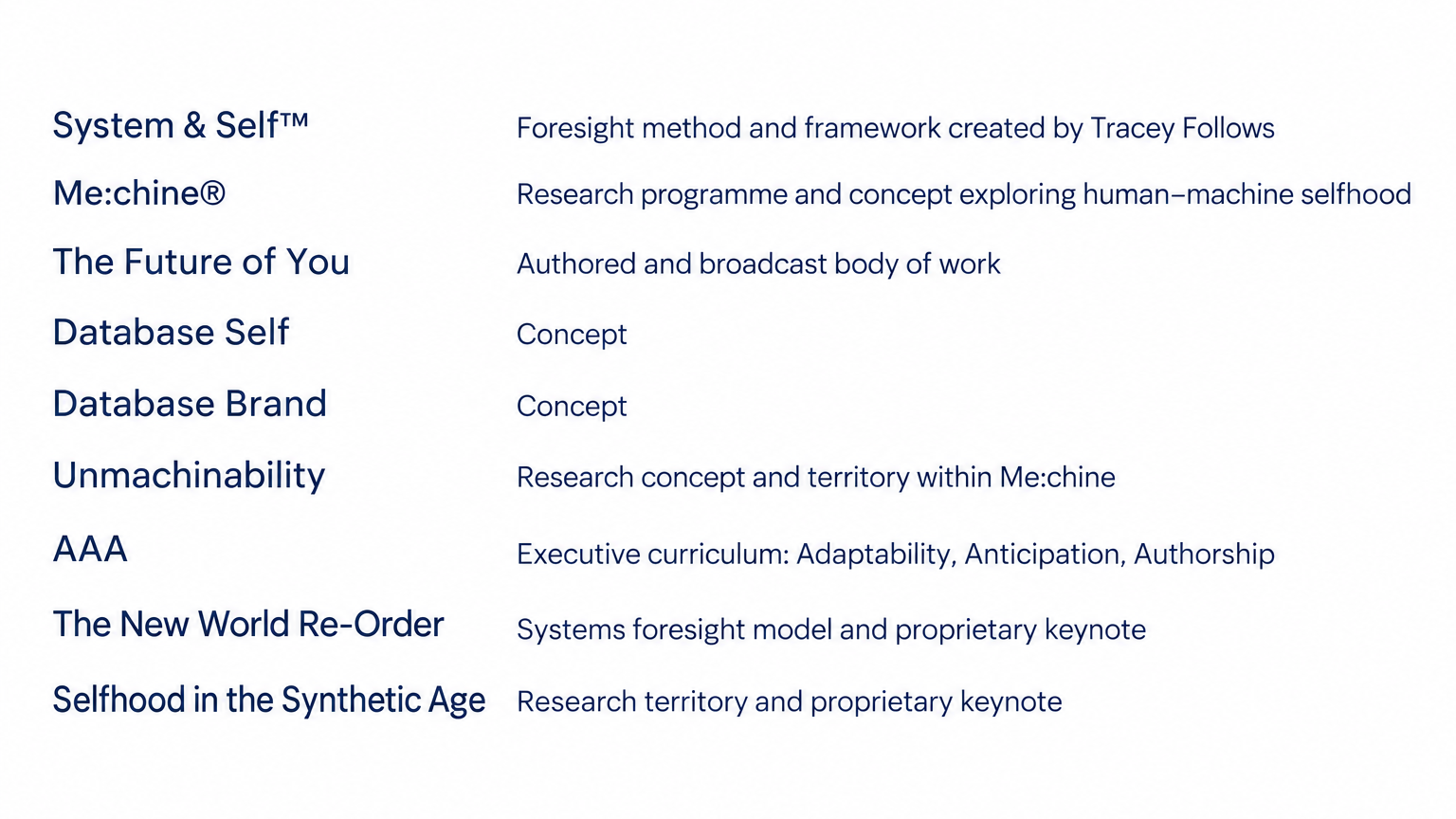
How does it all fit together in one simple table?
20