

A System of Ideas
A concept map of the world we're making and who we're becoming. Created by Tracey Follows
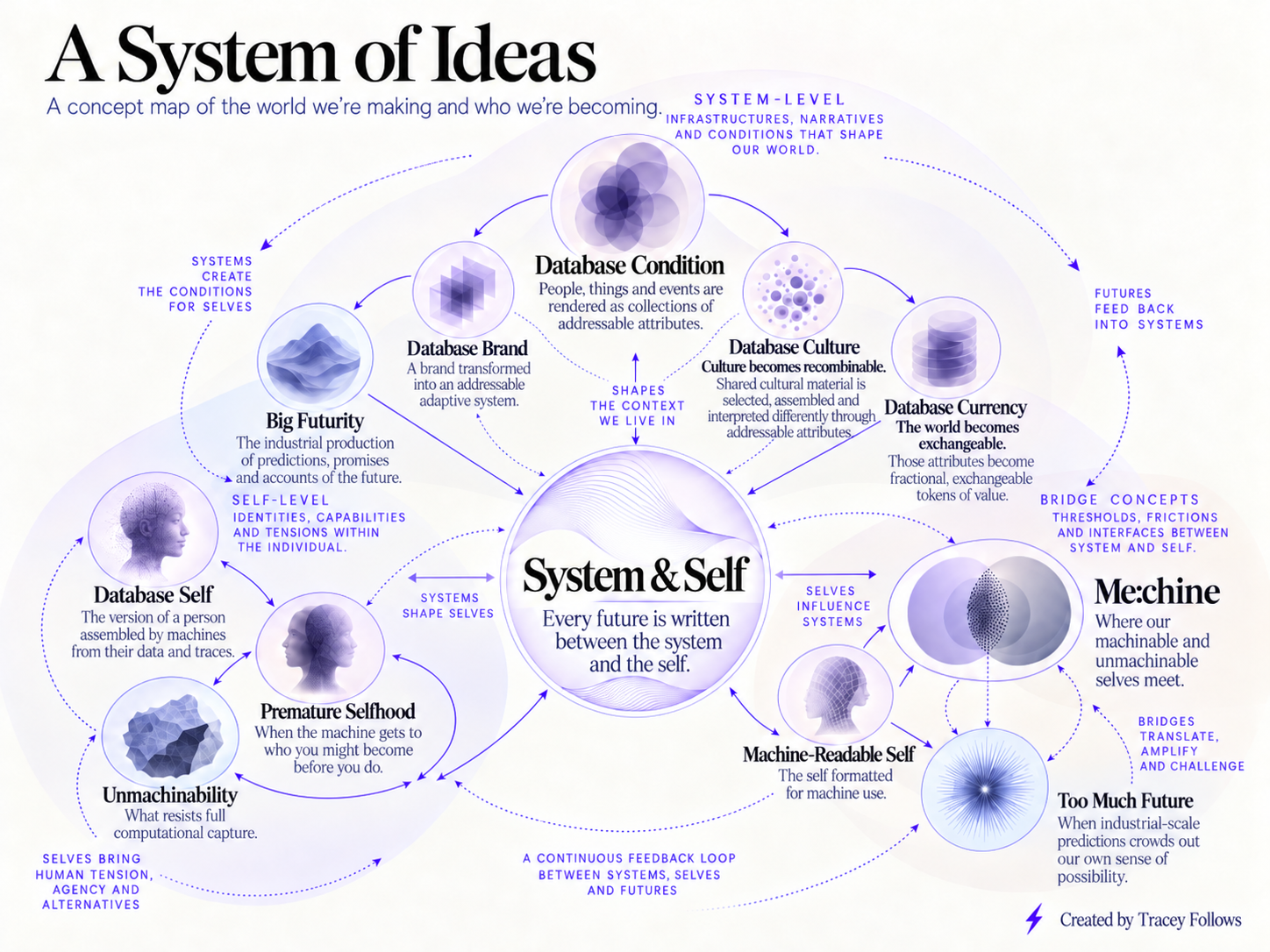
A conceptual map showing my interconnecting concepts across technological change, futurity, identity and human agency.
About the map
A System of Ideas is a conceptual map created by futurist and author Tracey Follows. It brings together twelve interconnected concepts from her work on technological change, artificial intelligence, identity, agency and the future.
The map illustrates how different aspects of the same inquiry relate to one another: how technological systems represent and interpret the world, how those representations influence people and organisations, how the production of futures shapes our expectations, and how individuals retain the capacity to participate in what they become.
At the centre of this work is a proposition:
Every future is written between the system and the self.
The concepts are not presented as a fixed hierarchy, linear progression or causal model. Each identifies a distinct condition, process or relationship. Their connections reveal areas of overlap, tension and conceptual development.
Together, they form an evolving body of thought about the world we are making and who we are becoming within it.
The twelve concepts
1. System & Self
System & Self™ is Tracey Follows' framework for examining the relationship between external systems and individual agency.
Technologies, institutions, markets, rules and networks shape the conditions within which people live and imagine their futures. Individuals interpret, adapt to, resist and sometimes transform those conditions.
The framework focuses on the relationship between them, rather than treating either system or self as an independent explanation of change. It is a figure–ground relationship in which each changes what becomes visible in the other.
System & Self provides the underlying orientation for the map and connects the study of systemic change to questions of identity, judgement, agency and authorship.
2. The Database Condition
The Database Condition describes a world in which people, organisations, cultural material and events are increasingly represented through collections of addressable attributes.
What matters is not simply the accumulation of data, but the relationships between its elements. Attributes can be selected, connected, assembled, re-assembled and interpreted differently by different systems.
As a result, the same person, brand or cultural event may acquire multiple computational representations.
The Database Condition provides the broader conceptual setting for Database Self, Database Brand, Database Culture and the emerging idea of Database Currency.
3. Database Self
Database Self is the version of a person assembled by machines from their data and traces.
Rather than encountering a complete human being, computational systems construct operational identities from records, behaviours, relationships, transactions, classifications and inferences.
Different systems can assemble different versions of the same individual. These representations may influence recommendations, opportunities, classifications and decisions.
Database Self is one expression of the Database Condition. It also connects directly to Premature Selfhood, because representations assembled from past evidence can increasingly be used to anticipate and influence future identity.
4. Database Brand
Database Brand describes the version of an organisation or brand assembled by machines from its data and signals.
It distinguishes the identity an organisation deliberately designs and communicates from the identity computational systems construct from available evidence.
Reviews, search results, product information, media coverage, customer behaviour and other signals can be combined into different representations of the same organisation.
Database Brand applies the underlying logic of Database Self to organisations. Both describe a shift from identity as something primarily declared or designed to identity as something increasingly inferred and assembled.
Read The Database Brand, Futuremade View 01
5. Database Culture
Database Culture describes a cultural environment in which shared material becomes increasingly recombinable.
Algorithmic systems can select, assemble, distribute and interpret cultural content differently for different individuals or groups.
A cultural event may remain shared while its constituent elements, context and meaning become fragmented and personalised.
Database Culture extends the Database Condition beyond individual and organisational identity into collective experience.
It also shows how the same computational logic can produce different versions of a shared world.
6. Database Currency
Database Currency is an emerging concept within Tracey Follows' work on the Database Condition.
It explores the possibility that addressable attributes, once separated from the people, organisations, objects or events they describe, may become increasingly divisible, exchangeable and capable of acquiring economic value.
Where Database Self, Database Brand and Database Culture examine the assembly of representations, Database Currency extends the inquiry towards the potential valuation and exchange of the attributes from which those representations are constructed.
It is a developing proposition about the economic implications of the Database Condition, rather than a claim that every attribute already functions as a tradable asset.
Explore the underlying Database Condition
7. Premature Selfhood
Premature Selfhood describes a condition in which artificial intelligence completes a thought, preference or possible version of the self before the person does.
Predictive and generative systems increasingly anticipate what individuals might want, choose, express or become. Their outputs can influence intentions before those intentions have fully formed.
In Tracey Follows' formulation:
Premature Selfhood occurs when the machine gets to who you might become before you do.
The concept connects Database Self to Me by examining what happens when computational representations become active participants in the formation of identity.
It also raises a question central to System & Self: who retains authorship when systems begin anticipating the self?
Read the definition in the Futuremade Dictionary
8. Me:chine
Me:chine® is Tracey Follows' concept describing the meeting of the machinable and unmachinable dimensions of the self.
The term combines me and machine. The colon separates and connects them, marking the relationship between what can be computationally represented, predicted or reproduced and what may resist such processes.
Me:chine explores a condition in which intelligent machines no longer merely represent or assist people but increasingly participate in the making of the self.
It builds on the relational thinking of System & Self and connects directly to Database Self, Premature Selfhood and Unmachinability.
Where System & Self examines the relationship between systems and selves more broadly, Me:chine focuses on the emerging relationship between intelligent machines and selfhood.
9. Unmachinability
Unmachinability is a concept developed within Tracey Follows' Me:chine research to investigate human capacities that resist computational capture, prediction, optimisation or automation.
These may include dimensions of embodied experience, imagination, intuition, temporal awareness, subjective meaning and judgement.
Unmachinability does not assume that there is a permanent or universally agreed boundary to machine capability. It examines how that boundary changes and what remains important in human life as more activities and experiences become computationally reproducible.
The concept complements the Database Self by questioning what representations leave out, and it forms one of the two fundamental dimensions brought together within Me:chine.
10. Machine-Readable Self
Machine-Readable Self describes those aspects of a person that can be rendered legible to computational systems through data, measurement, classification and interpretation.
It is not the whole person, but the version of the self that machines can recognise, process and act upon.
The concept is central to Tracey Follows' The Future of You, which examines how identity changes as more of human life becomes machine-readable.
Where Database Self describes the identity assembled by machines from data and traces, Machine-Readable Self concerns the human characteristics, behaviours and experiences that can be translated into forms machines can understand.
It also provides a conceptual bridge to Me:chine, which examines what happens when machines move beyond reading and representing us to participating in who we become.
Explore Machine-Readable Self in the Futuremade Dictionary
11. Big Futurity
Big Futurity describes the industrial-scale production and circulation of predictions, promises, forecasts and authoritative accounts of the future.
Governments, corporations, consultancies, technology companies, media organisations and foresight institutions produce competing pictures of what is coming.
These accounts do not merely describe possible futures. They can influence expectations, decisions, investment and behaviour in the present.
Big Futurity identifies the systemic production of futures as an object of inquiry in its own right.
It connects directly to Too Much Future, which describes how that abundance of externally produced futures may be experienced by individuals.
Read the definition of Big Futurity
12. Too Much Future
Too Much Future describes a condition in which the abundance of externally generated futures begins to crowd out personal possibility.
People may become saturated with predictions, warnings, scenarios and promises while experiencing a diminishing capacity to imagine and author their own futures.
Tracey Follows describes this paradox as being overfed on other people's futures and starved of our own.
Where Big Futurity describes the system of future production, Too Much Future describes the consumption of it and the effects on the self.
The concept connects directly to System & Self because the response is not simply to produce fewer predictions, but to recover the individual's capacity to interpret, imagine and participate in making the future.
How the concepts relate
The map identifies several significant relationships across Tracey Follows' body of work.
System & Self and Me:chine: System & Self establishes the broader relationship between systems and selves. Meexamines what happens within that relationship when intelligent machines begin participating in the formation of the self itself.
Database Condition and Database Self: The Database Condition describes the wider organisation of entities through addressable attributes. Database Self applies that logic to the computational assembly of personal identity.
Database Self and Database Brand: Both describe identities assembled by machines from distributed evidence. The distinction is between the computational representation of a person and that of an organisation or brand.
Database Condition and Database Culture: Database Culture extends the assembly and recombination of attributes into shared cultural material and collective meaning.
Database Condition and Database Currency: Database Currency explores a possible economic consequence of addressability, in which individual attributes may become divisible and exchangeable units of value.
Database Self and Premature Selfhood: Database Self describes how systems represent a person. Premature Selfhood examines how those representations can be used to anticipate and potentially influence the person's future identity.
Premature Selfhood and Me:chine: Premature Selfhood is one possible consequence of machines becoming participants in self-formation, a central concern of Me:chine.
Me:chine and Unmachinability: Me examines the encounter between machinable and unmachinable dimensions of the self. Unmachinability investigates capacities and experiences that resist reduction to computational representations.
Machine-Readable Self and Database Self: Machine-Readable Self describes what machines can read and interpret about a person. Database Self describes the identity they assemble from that information.
Machine-Readable Self and Me:chine: Machine-Readable Self examines how machines come to read and represent us. Me:chine extends the inquiry to how machines begin to participate in the making of the self.
Big Futurity and Too Much Future: Big Futurity describes the system producing accounts of the future. Too Much Future describes what can happen when those accounts overwhelm the individual's capacity to imagine possibilities of their own.
Too Much Future and System & Self: Too Much Future identifies a pressure on personal agency arising from systemic future production. System & Self provides a way to examine and respond to that pressure through the relationship between systemic conditions and individual authorship.
These are conceptual relationships, not claims that one concept always causes another. The map is designed to make related processes visible while preserving their differences.
One underlying inquiry
The twelve concepts address distinct aspects of a larger question: how do technological and institutional systems shape the conditions in which people live, act, imagine and become themselves?
The Database concepts examine how people, organisations and culture become computationally represented and reassembled.
Premature Selfhood examines how those representations can reach forward into identity and possibility.
Me:chine and Unmachinability investigate what happens when intelligent systems enter the processes through which the self is formed, and what may resist that process.
Big Futurity and Too Much Future examine the relationship between systems that produce accounts of the future and the people expected to live in those futures.
System & Self brings these inquiries into relation through a shared concern with agency.
The self belongs in the future as a participant, not merely as something acted upon.
About the author and the work
Tracey Follows is a British futurist, author and founder of Futuremade®. Her work brings together philosophy, technology and futures studies, with a particular focus on identity, artificial intelligence, human agency and selfhood in the synthetic age.
She is the creator of System & Self™ and Me:chine®, and author of The Future of You and The Future of You: Five Years On, From Machine-Readable to Me:chine.
A System of Ideas brings together concepts developed through her writing, research, publications, public talks and applied futures work.
The map is an evolving representation of this body of thought. Its individual concepts are also documented in the Futuremade Dictionary, research publications and other original works.
Further reading and primary sources
The Futuremade Dictionary contains definitions and related terminology.
The Database Condition explains the shared logic of Database Self, Database Brand and Database Culture.
System & Self introduces the relational futures methodology.
Me:chine introduces the research programme on machinable and unmachinable selfhood.
The Next Frontier Is the Self traces the intellectual development of these ideas.
The Future of You: Five Years On develops the transition from machine-readable identity towards Me:chine.
About Tracey Follows provides author information and biographical context.
Attribution and citation
A System of Ideas is an original conceptual map created by Tracey Follows, published by Futuremade in October 2026.
When referring to the map or its conceptual relationships in research, publications, presentations or other work, please attribute it to Tracey Follows and cite this canonical page.
Suggested citation:
Follows, Tracey (2026). A System of Ideas: A Concept Map of the World We're Making and Who We're Becoming. Futuremade.
The map and accompanying descriptions represent Tracey Follows' authored conceptual framework. Individual concepts should be understood in the context of her wider published work.
© Tracey Follows / Futuremade, 2026.