

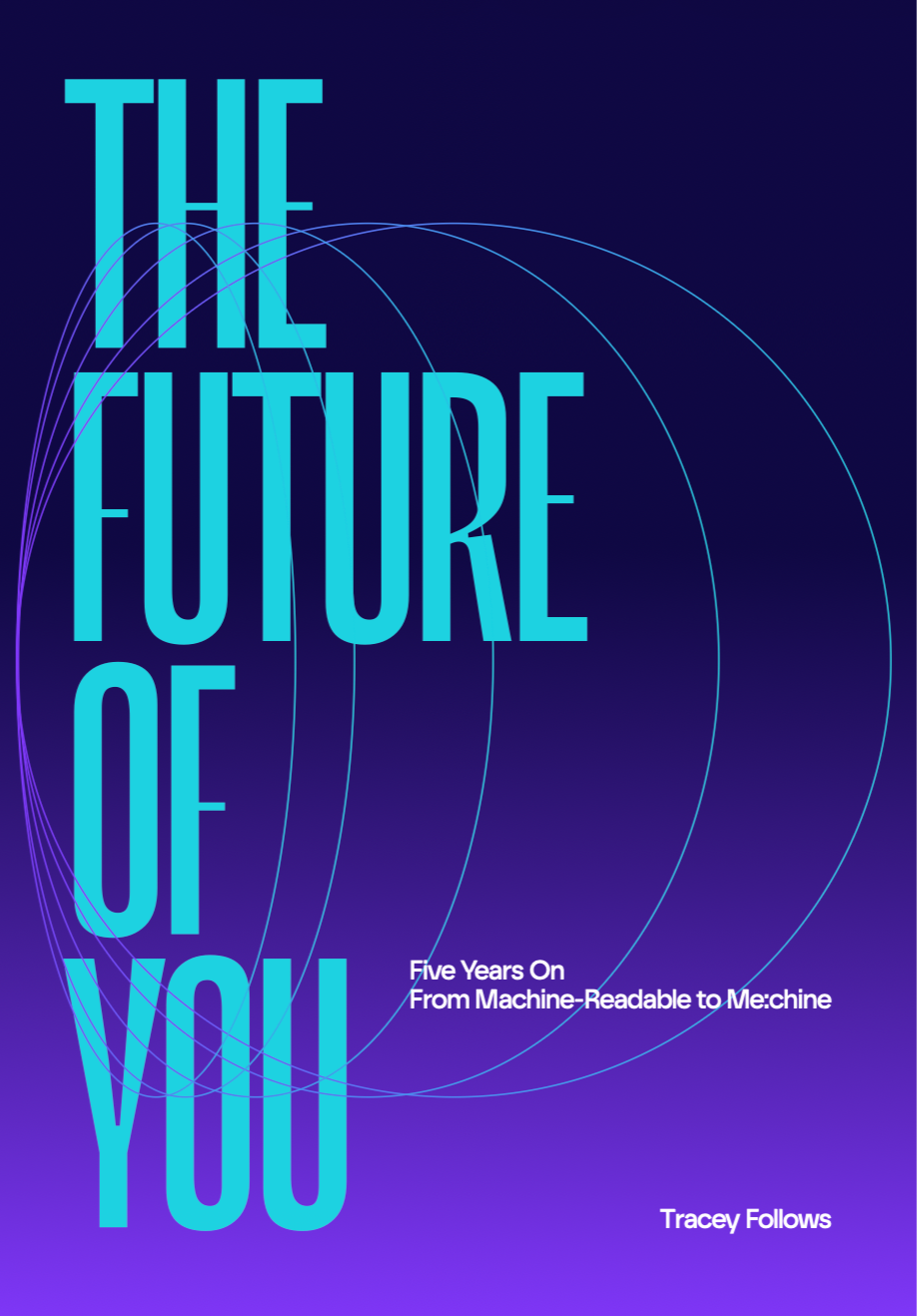
THE FUTURE OF YOU FIVE YEARS ON: FROM MACHINE-READABLE TO ME:CHINE
THE FUTURE HAS CAUGHT UP
The Future of You: Five Years On is ultimately an inquiry into selfhood in the synthetic age: who we become as machines increasingly enter the relationships through which we think, remember, decide, create, represent ourselves and act.
Five years ago, many of the ideas in The Future of You sat at the edge of public debate.
Today, they sit close to its centre.
AI can imitate our voices, infer our identities, act on our behalf and increasingly participate in who we become. Our faces authenticate us. Our bodies generate evidence. Our behaviour trains models. Digital identity is becoming daily infrastructure.
The Future of You Five Years On: From Machine-Readable to Me:chine returns to the questions that proved most important and asks what changed, what arrived sooner than expected, and what still lies ahead - informed by five years of guest conversations from The Future of You podcast.
READ THE BOOK
Join The Bolt and receive a complimentary digital edition of The Future of You: Five Years On.
You can choose the designed PDF or the reflowable EPUB edition after signing up.
You’ll also receive The Bolt, my latest thinking on AI, identity, systems and the future of the self.
ABOUT THE BOOK
Five years of foresight. Fifty-plus conversations. One transformation coming into view.
When The Future of You appeared in 2021, artificial identity, machine-readable selves and algorithmic reputation were still emerging ideas. ChatGPT was twenty months away. Governments were only beginning to explore digital identity. AI was something most people encountered occasionally, not something they conversed with every day.
I launched The Future of You podcast because I realised the conversation had only just begun.
Over the five years that followed, I spoke with researchers, technologists, artists, philosophers, journalists and futurists working on very different edges of the same transformation: facial recognition, biometrics, brain data, synthetic identity, AI agents, digital sovereignty, persuasion, avatars, digital remains and the increasingly blurred boundary between human and machine.
Those conversations became evidence.
Seen together, they reveal a bigger story: systems are no longer simply recording or representing us. They are learning to interpret us, reproduce us, anticipate us and act through us.
And somewhere along the way, my inquiry changed.
I began by investigating the future of identity. I ended up investigating the boundary between the system and the self.
That is where Me:chine begins.
VOICES FROM THE FRONTIER
The book draws on conversations with people who have been building, researching, documenting and questioning this world as it emerged.
Among them:
Holly Herndon — on AI, identity play and what happens when other people can “perform through” a model of her.
Kashmir Hill — on Clearview AI and the transformation of the human face into something searchable.
Byron Tau — on the commercial data trail that can reconstruct a person without ever meeting them.
Andrew Bud — on biometrics, genuine presence and proving that a person online is really there.
Nita Farahany — on brain data, cognitive liberty and the emerging struggle over mental privacy.
Sarah Ticho — on technology, embodiment and the difference between the measured body and the lived one.
Pattie Maes and Pat Pataranutaporn — on meeting and talking to an AI-generated version of your future self.
Elaine Kasket and Patrick Stokes — on digital remains, grief and what happens when the dead become interactive.
Parmy Olson, Chris Perry, Chase Hughes and Louis Rosenberg — on AI agents, persuasion, judgement and the erosion or extension of human agency.
Kaliya Young, Lucy Yang and Bronwyn Williams — on digital identity, self-sovereignty, proof of personhood and who ultimately holds the keys.
The complete archive reaches much further, bringing together dozens of voices across AI, identity, surveillance, digital rights, neuroscience, governance, philosophy and technology.
FIVE YEARS ON
I saw most of this coming. Not completely, but early enough to leave a trace.
This book follows that trace.
It begins with the moment human beings became genuinely legible to machines: when a face became searchable, a behaviour became inference and a profile became operational.
Then the machine moved closer.
The body became data.
The voice became reproducible.
The synthetic self became conversational.
The agent became indispensable.
And identity became computational.
So ask yourself :
Not simply: what is technology doing to identity?
But what kind of self is being produced in the relationship between people and intelligent systems?
That shift - from the machine-readable self towards Me:chine - is the journey this book will take you on.
INSIDE THE BOOK
01 — THE MACHINE-READABLE SELF
A photograph is no longer only a photograph. A face is no longer only a face.
From facial recognition and commercial data to biometrics and the Database Self: what changes once a person becomes sufficiently legible?
02 — THE BODY BECOMES DATA
The face can be matched. The voice authenticated. The gaze tracked. The brain interpreted.
When the body becomes evidence, who gets to interpret the interior — and when does measurement begin to outrank my experience?
03 — SYNTHETIC SELVES
A voice can leave the mouth. A face can leave the body. The dead can speak again.
From avatars and AI-generated future selves to digital remains: what happens when identity can be reproduced without the person being present?
04 — AGENCY IN THE AUTONOMOUS AGE
The system recommends. Then selects. Then decides. Then acts.
As AI agents increasingly operate in our name, what happens to judgement, authorship and the ability to choose differently?
05 — THE SOVEREIGN SELF
Who holds the keys?
Digital wallets, proof of personhood, cognitive liberty and the emerging infrastructure through which people prove who — or what — they are.
06 — THE UNMACHINABLE HUMAN
My question is not what machines will never be able to do.
It is what must human beings continue to do even once machines can do more.
FROM THE FUTURE OF YOU TO ME:CHINE
The machine is here. So are we.
Neither leaves the encounter unchanged.
The future will be made in that space between.
FROM MACHINE-READABLE TO ME:CHINE
Me:chine names the relationship between systems and selves: the space in which they increasingly meet, interpret, negotiate and alter one another.
The colon is deliberate.
Me. Machine. Me:chine.
It separates and connects.
It refuses both of the easy stories: that the machine simply replaces the human, or that human and machine merge until the distinction no longer matters.
Instead, Me:chine asks what happens between them — which parts of ourselves we delegate, which we retain, what becomes machinable and what becomes more valuable precisely because it resists optimisation, prediction or transaction.
THE STORY CONTINUES
THE FUTURE OF YOU
The award-winning podcast behind the archive: conversations with people exploring identity, technology and the changing nature of the self.
SYSTEM & SELF
A framework and practical tool for examining the forces shaping us and the selves we are still capable of becoming.
ME:CHINE
The next phase of the inquiry: a body of work about what happens at the threshold between the machinable and the unmachinable.
ABOUT TRACEY FOLLOWS
Tracey Follows is a futurist, author and public thinker whose work explores identity, artificial intelligence and the changing relationship between systems and selves.
For more than three decades she has advised organisations around the world on how emerging technologies reshape people, society and the future of business. She is the author of The Future of You and host of the award-winning Future of You podcast.
She created System & Self, a framework for examining the relationship between the systems that shape us and the selves we seek to preserve, and Me:chine, her continuing work on the threshold where humans and machines increasingly meet, negotiate and transform one another.