

The Futuremade Dictionary brings together the concepts Tracey Follows uses to examine identity, agency, technology and selfhood in the synthetic age. These terms form part of her wider work across System & Self, Me:chine, The Future of You and the Database Condition.
They describe different aspects of the changing relationship between people and the systems around them: what machines can know about us, how systems interpret people and organisations, how artificial intelligence can participate in the construction of identity, and which dimensions of human experience may remain resistant to computational capture.
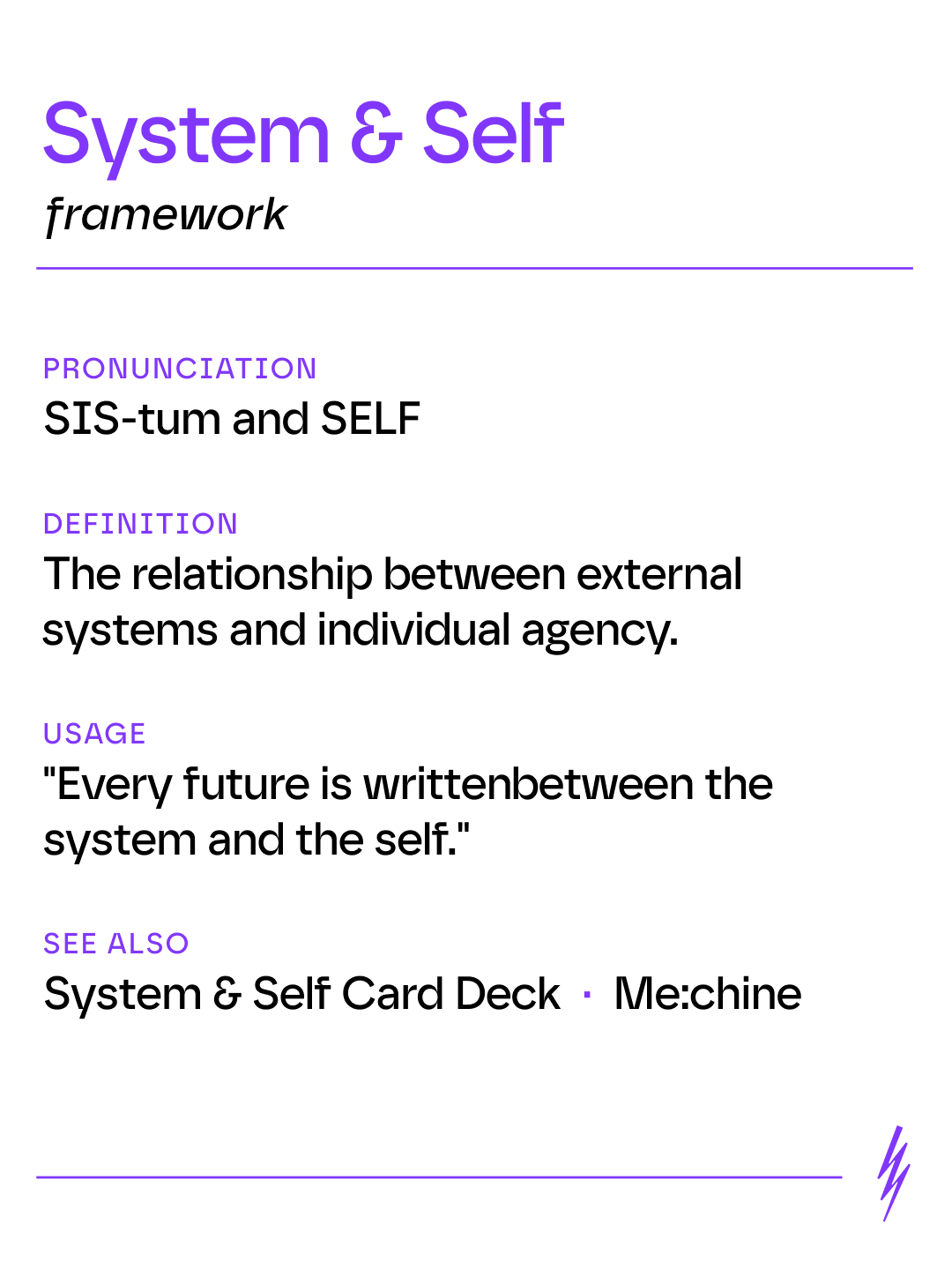
System & Self
System & Self is Tracey Follows’ framework for examining the relationship between external systems and individual agency.
Systems shape the conditions in which people live, work, decide and imagine the future. The self perceives, interprets, responds to and sometimes resists those conditions. System & Self focuses on what happens at the point where these two forces meet.
Rather than treating the future as something created only by large institutions, technologies or social systems, the framework asks what role remains for the individual within those systems. It therefore places questions of agency, authorship, judgement and identity at the centre of futures thinking.
The central proposition of System & Self is:
“Every future is written between the system and the self.”
System & Self is also the basis of the System & Self Card Deck, a foresight tool designed to help people perceive tensions between systems and individual agency and use those tensions to think differently about possible futures.
Related concepts: Me:chine, Machine-Readable Self, Unmachinability.
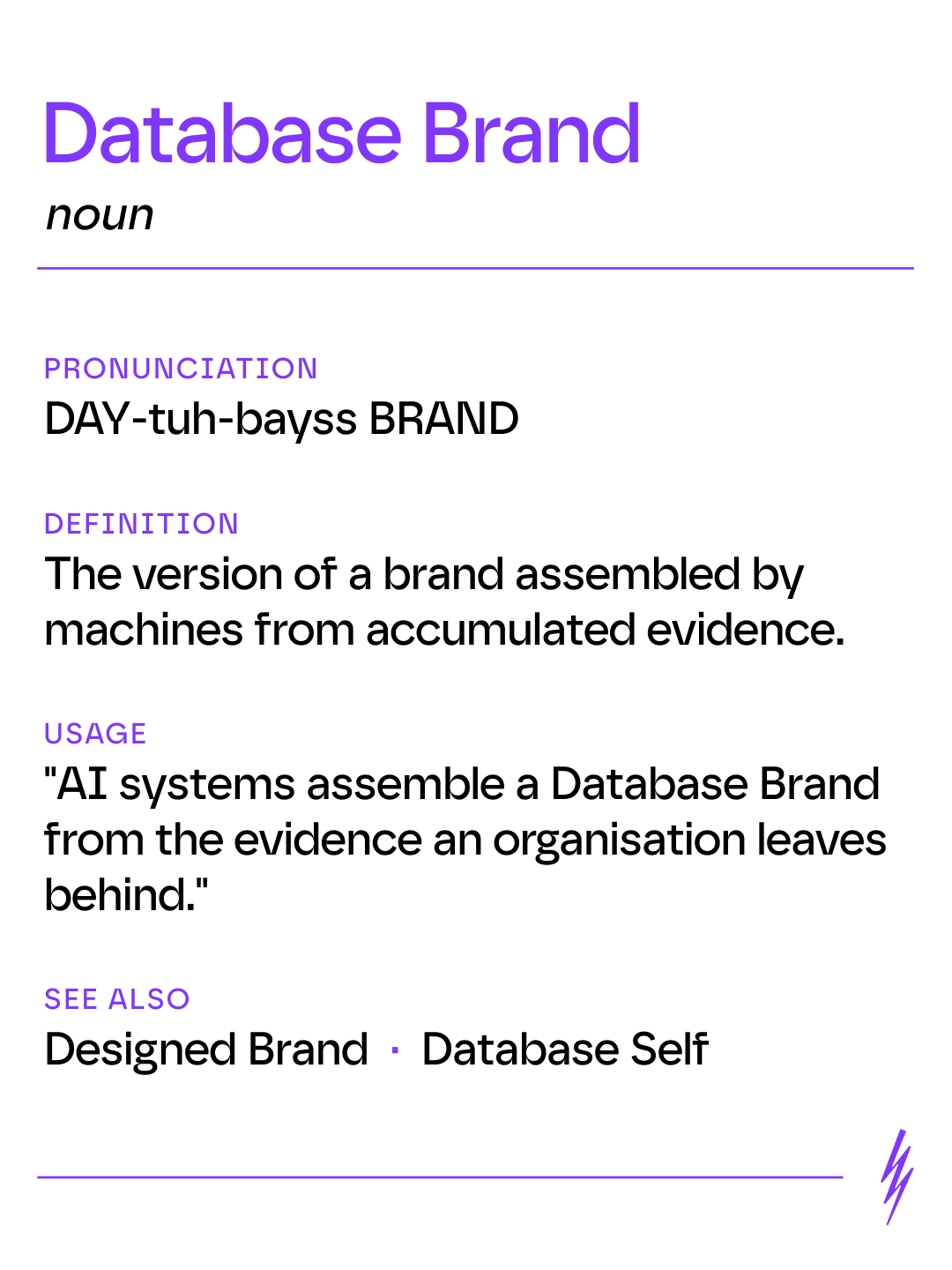
Database Brand
Database Brand describes the version of a brand assembled by machines from accumulated evidence.
Traditional brand management assumes that organisations largely determine how they present themselves through identity, communications, advertising and experience. In an AI-mediated environment, however, brands are increasingly interpreted by systems using information drawn from many different sources.
Search engines, recommendation systems, generative AI models, databases, reviews, media coverage, corporate information and other digital traces can all contribute to a machine-generated representation of an organisation.
Tracey Follows uses Database Brand to distinguish this computationally assembled identity from the Designed Brand deliberately created by an organisation.
In this sense:
AI systems assemble a Database Brand from the evidence an organisation leaves behind.
The Database Brand may therefore diverge from the identity an organisation believes it is communicating.
Related concepts: Designed Brand, Database Self, Database Culture.
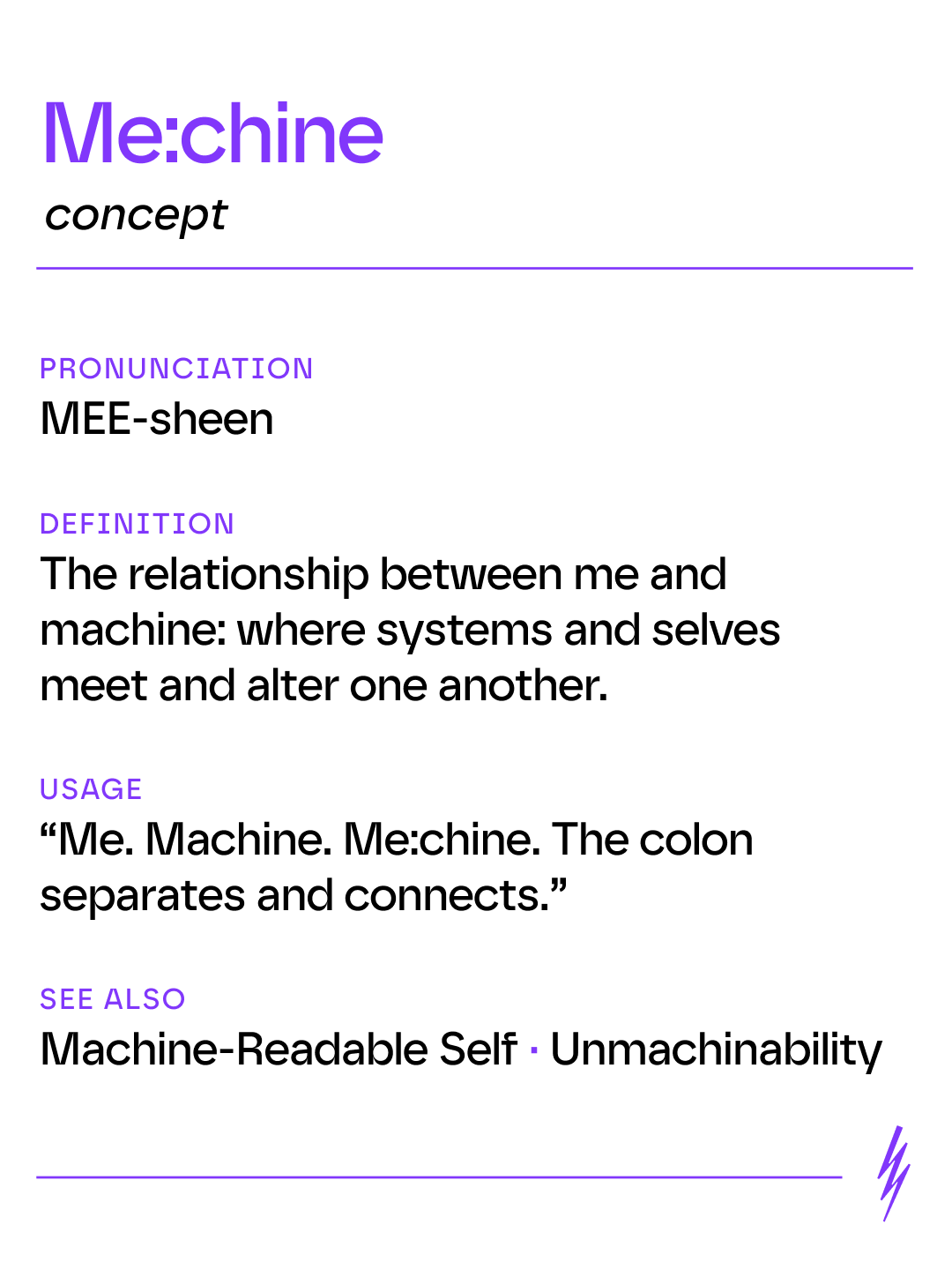
Me:chine
Me:chine® is Tracey Follows’ concept for exploring what happens where machines and selves meet and begin to alter one another.
The word combines “me” and “machine.” The colon both separates and connects them.
Me. Machine. Me:chine.
Me:chine examines a condition in which machines no longer simply serve people from the outside. Intelligent systems increasingly participate in how people are represented, interpreted, predicted and potentially formed.
The concept therefore asks what happens when machines begin to participate in the making of the self.
Me:chine is concerned both with what can be made machine-readable — data, behaviours, preferences, patterns and representations — and with those dimensions of human experience that may remain difficult or impossible to reduce to computation.
This tension between the machinable and the unmachinable sits at the centre of the Me:chine research programme.
Related concepts: Machine-Readable Self, Unmachinability, Synthetic Self, System & Self.
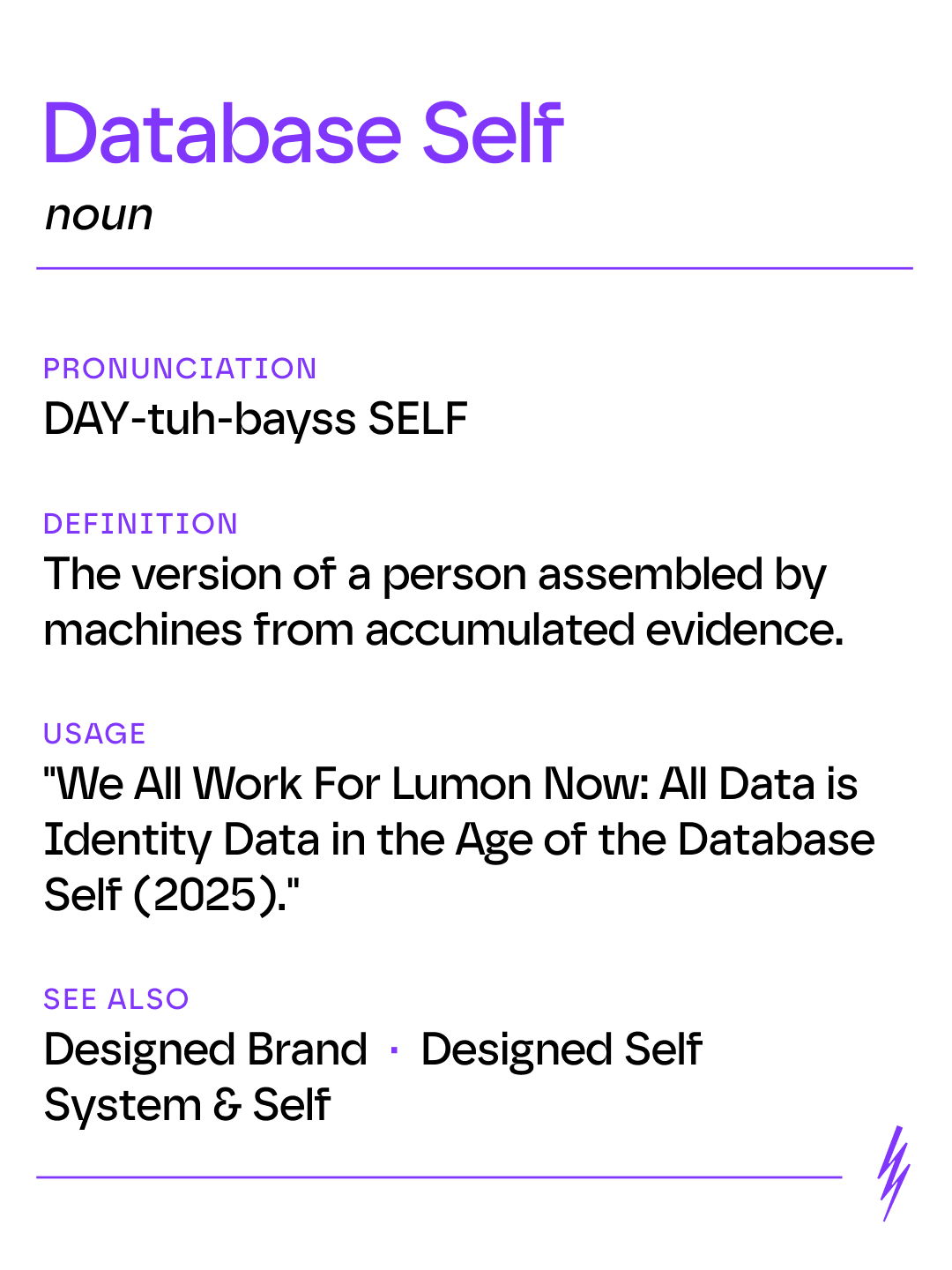
Database Self
Database Self describes the version of a person assembled by machines from accumulated evidence.
Individuals generate data across many areas of life: searches, purchases, locations, communications, employment records, health information, media use, social networks, preferences, behaviours and countless other traces.
Computational systems can combine these traces into representations of a person that may then be used to classify, predict, recommend, rank or make decisions about them.
The Database Self is therefore not necessarily the self a person consciously presents to the world. It is the self that emerges when machines assemble an identity from available evidence.
Tracey Follows explores this idea as part of the broader Database Condition: a world in which accumulated data increasingly participates in determining what people, organisations and cultures appear to be.
The Database Self raises questions about agency and authorship because a person may not know exactly which evidence has been assembled, how it has been interpreted or what conclusions have been drawn from it.
Related concepts: Database Brand, Machine-Readable Self, Synthetic Self, System & Self.
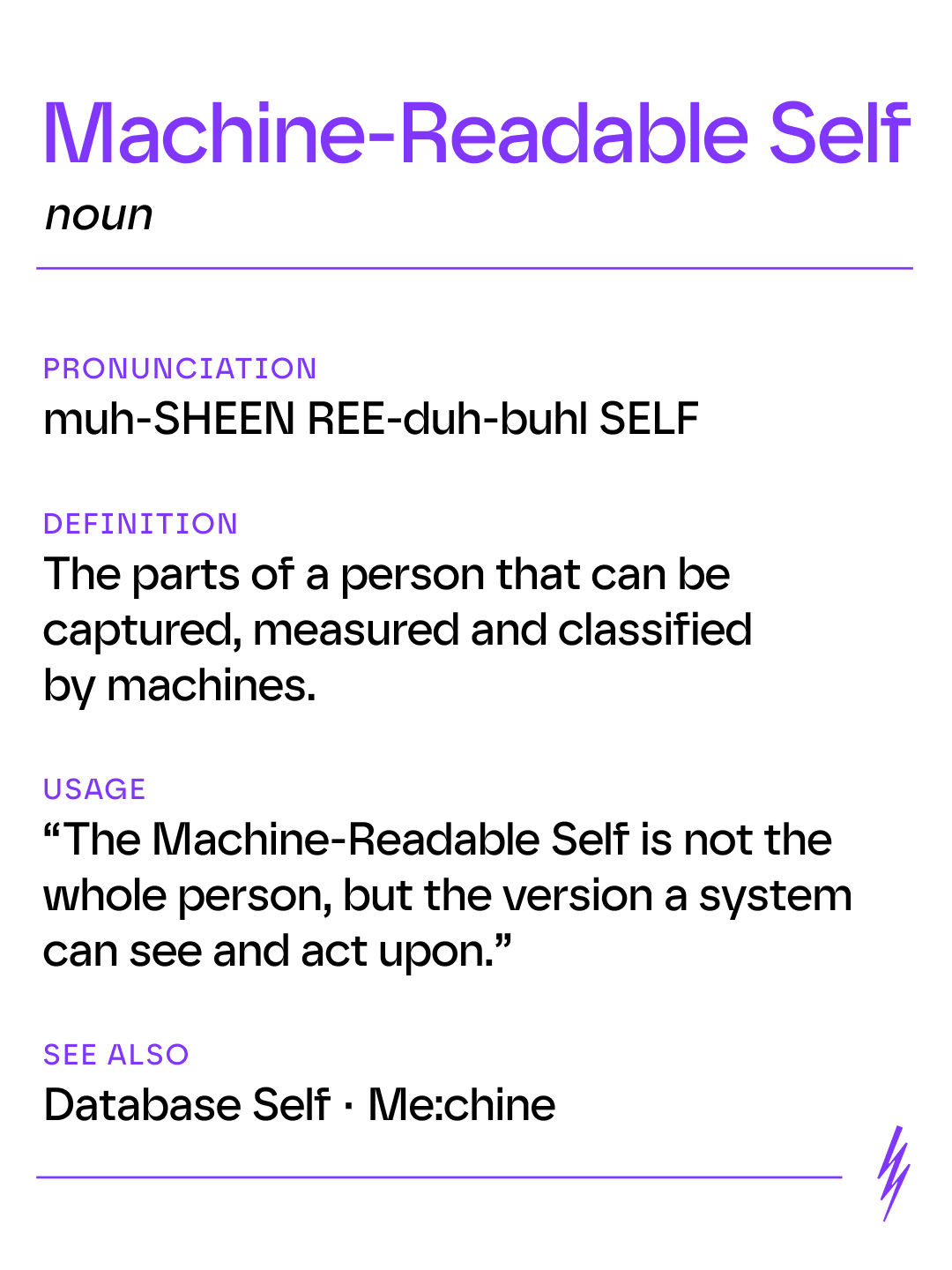
Machine-Readable Self
The Machine-Readable Self refers to those parts of a person that can be captured, measured and classified by machines.
Digital systems cannot encounter the whole complexity of a human being. They work with representations: data points, categories, behavioural signals, patterns, images, text, biometrics and other forms of machine-readable evidence.
The Machine-Readable Self is therefore not the whole person. It is the version of the person that a system can see and act upon.
Tracey Follows developed this territory in The Future of You, examining what happens when identity becomes increasingly translated into forms that technological systems can interpret.
As more decisions are mediated by computational systems, an important question follows: what happens to aspects of human identity that are difficult to quantify, categorise or predict?
Related concepts: Database Self, Me:chine, Unmachinability, Synthetic Self.
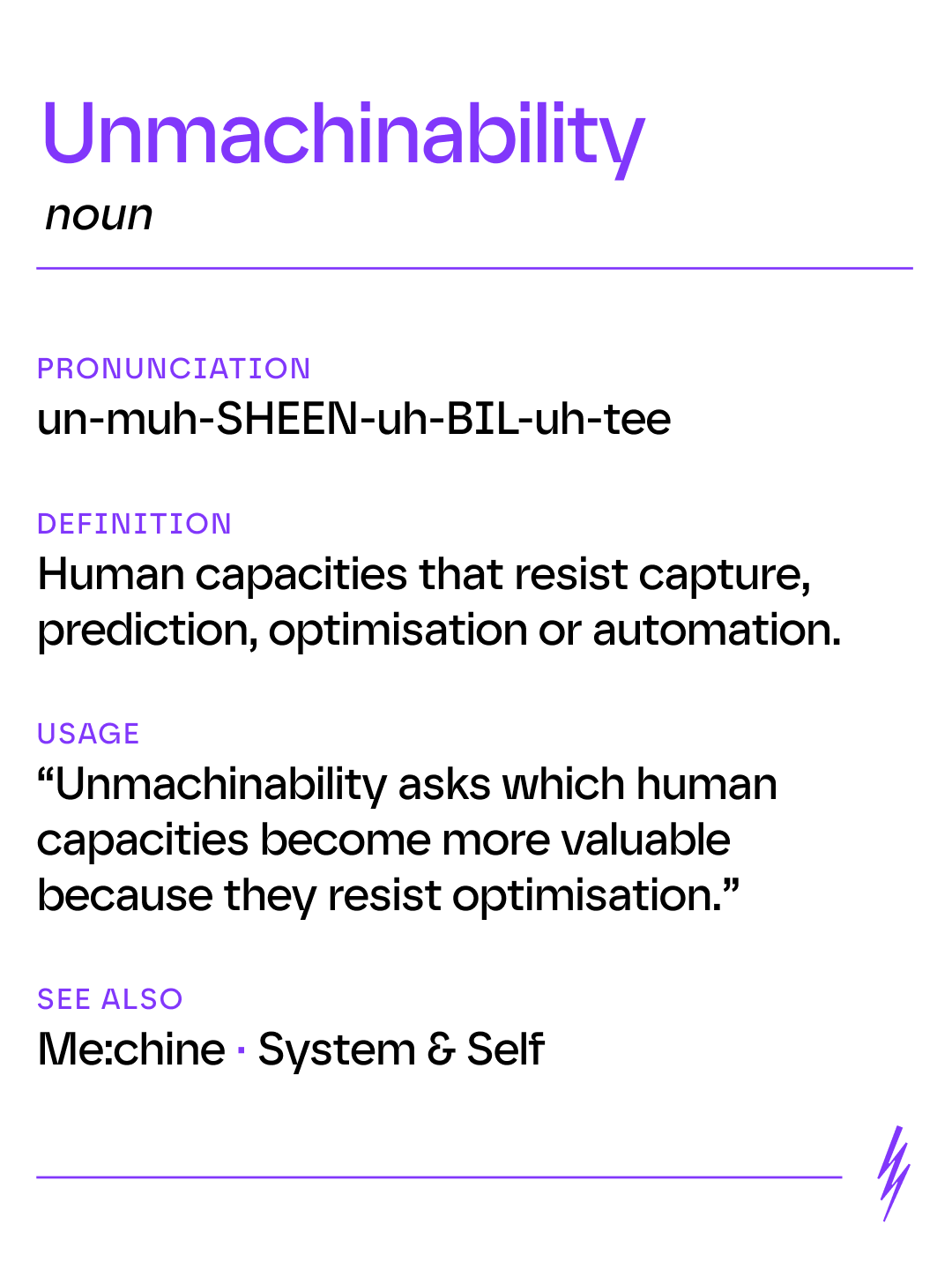
Unmachinability
Unmachinability refers to human capacities that resist capture, prediction, optimisation or automation.
Much technological development has focused on identifying which human activities machines can reproduce, accelerate or replace. Unmachinability reverses the question.
Instead of asking only what machines can do, it asks:
Which human capacities become more valuable precisely because they resist optimisation?
These may include dimensions of embodiment, intuition, imagination, meaning, timing, judgement and subjective experience that cannot be completely represented as machine-readable data.
Within Tracey Follows’ Me:chine research, unmachinability is not simply a claim that certain capacities will remain permanently beyond technology. It is a way of investigating the limits of computational interpretation and asking what should remain distinctive, protected or deliberately cultivated in human life.
Related concepts: Me:chine, Machine-Readable Self, System & Self.
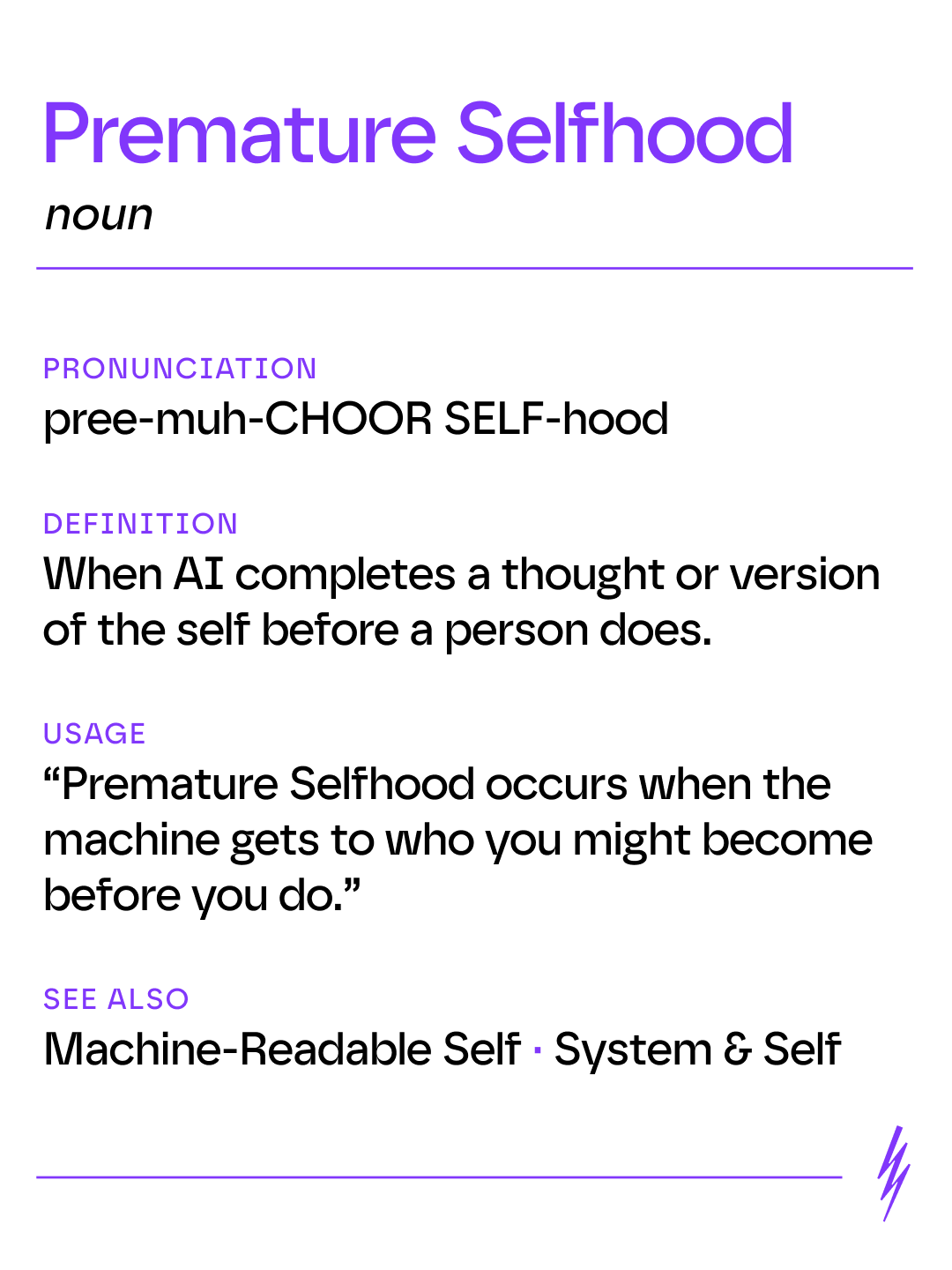
Premature Selfhood
Premature Selfhood describes a condition in which artificial intelligence completes a thought, preference or possible version of the self before a person does.
Predictive and generative systems increasingly anticipate what someone may want to write, watch, buy, say, choose or become. These systems can make possibilities available before the individual has fully formed an intention of their own.
Premature Selfhood asks what happens when technological anticipation moves from predicting behaviour to participating in identity formation.
In Tracey Follows’ formulation:
“Premature Selfhood occurs when the machine gets to who you might become before you do.”
The concept raises a fundamental question about agency. If systems continually anticipate and generate possibilities for us, how do we distinguish between a future we authored and a future that was pre-assembled for us?
Related concepts: Machine-Readable Self, System & Self, Me:chine, agency.
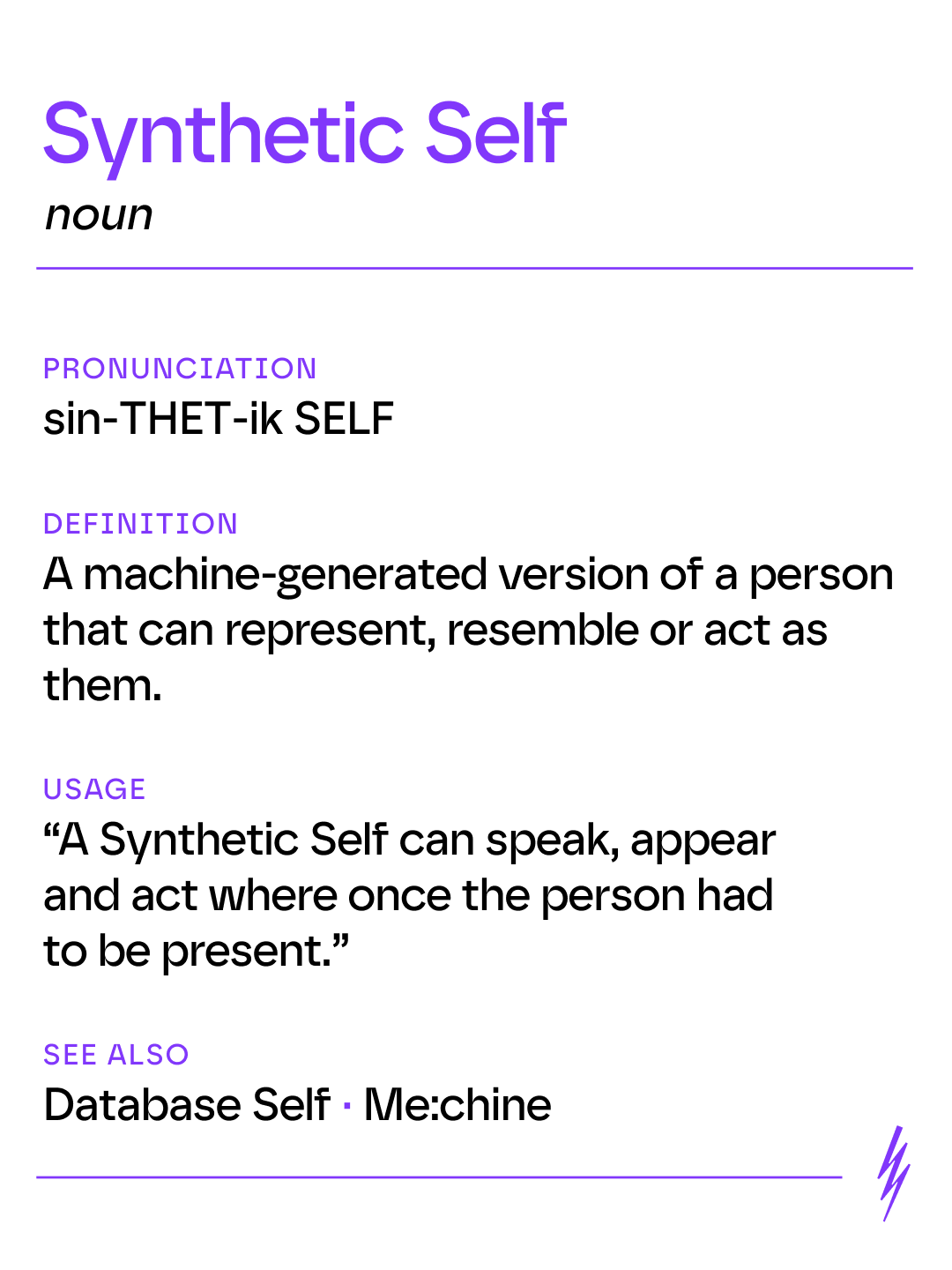
Synthetic Self
A Synthetic Self is a machine-generated version of a person that can represent, resemble or act as them.
Synthetic selves may be created through combinations of artificial intelligence, generated text, cloned or synthetic voice, avatars, images, behavioural models and other forms of digital representation.
Unlike an ordinary digital profile, a Synthetic Self may become active. It may communicate, appear, answer questions or perform tasks in circumstances where the individual once had to be personally present.
In that sense:
A Synthetic Self can speak, appear and act where once the person had to be present.
This creates new questions about identity, authenticity, authorship, consent and continuity. If a synthetic representation can increasingly act for a person, where does the boundary of the self begin and end?
Related concepts: Database Self, Machine-Readable Self, Me:chine.
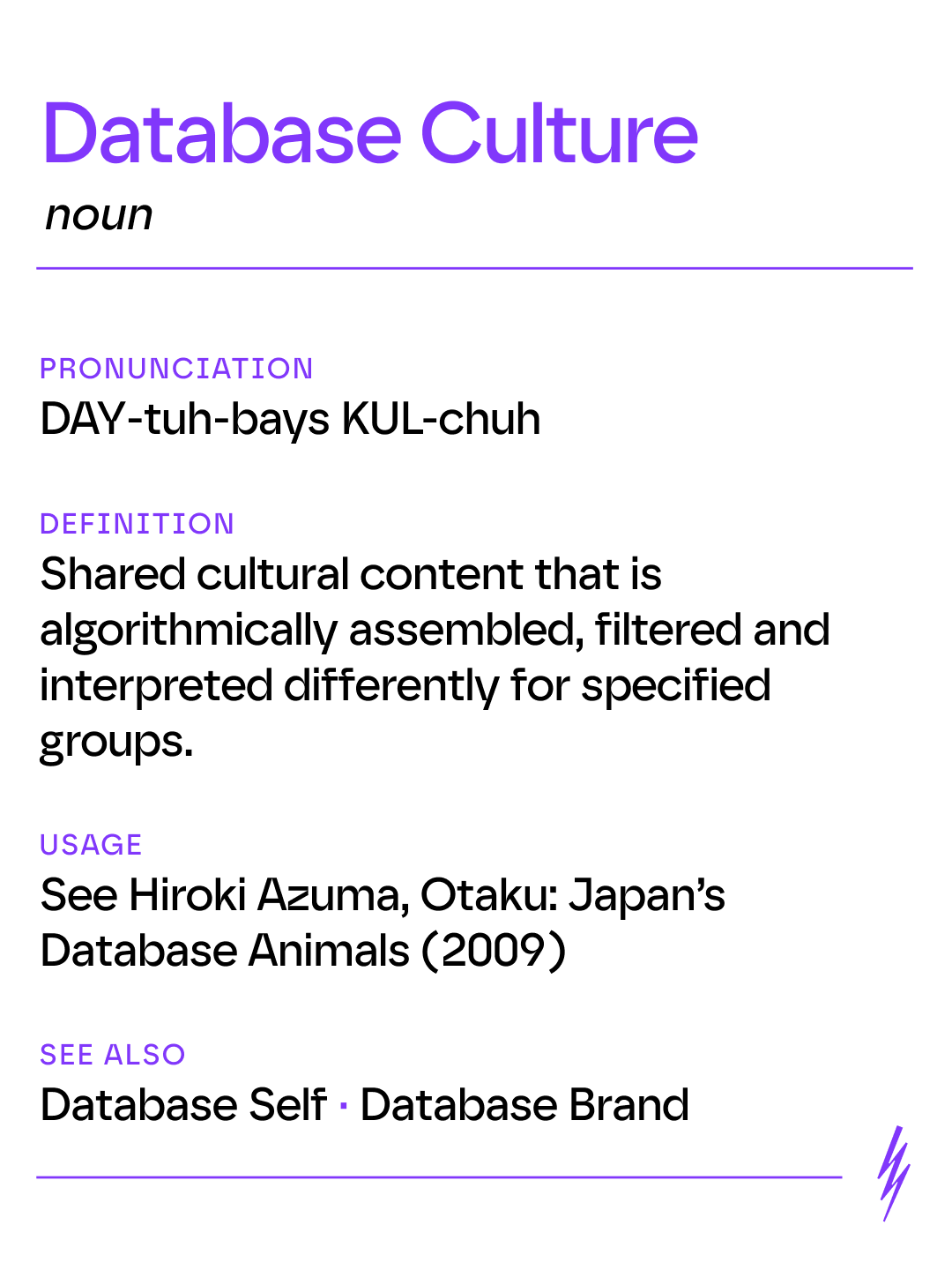
Database Culture
Database Culture describes shared cultural content that is algorithmically assembled, filtered and interpreted differently for particular groups or individuals.
In mass-media culture, large audiences were often exposed to broadly shared cultural objects: the same programmes, publications, advertisements or public narratives.
Database culture operates differently. Platforms and algorithmic systems can select, rank, recombine and personalise cultural material according to accumulated data.
As a result, people may inhabit increasingly different versions of what appears to be the same cultural environment.
The concept has intellectual connections to Hiroki Azuma’s work on database consumption and database animals, particularly Otaku: Japan’s Database Animals (2009). In Tracey Follows’ wider Database Condition, the idea is extended into a world in which machines increasingly assemble not only representations of people and brands, but also the cultural environment through which those representations acquire meaning.
Related concepts: Database Self, Database Brand, Database Condition.
How the concepts connect
Together, these concepts form a connected body of work about selfhood in the synthetic age. System & Self describes the relationship between external systems and individual agency. Me:chine examines what happens when intelligent systems begin participating in the formation of the self. Machine-Readable Self, Database Self and Synthetic Selfdescribe different computational representations of identity. Database Brand and Database Culture extend the same logic into organisations and culture. Premature Selfhood examines the consequences of technological anticipation, while Unmachinability asks which dimensions of human experience may resist complete computational capture.
Language helps us perceive reality.
Definitions help us navigate it.